
We are pleased to offer piano restoration of the highest possible standard. We have over thirty years of experience and regularly update our knowledge by attending courses by Steinway, Renner, The Piano Tuners Association and others.
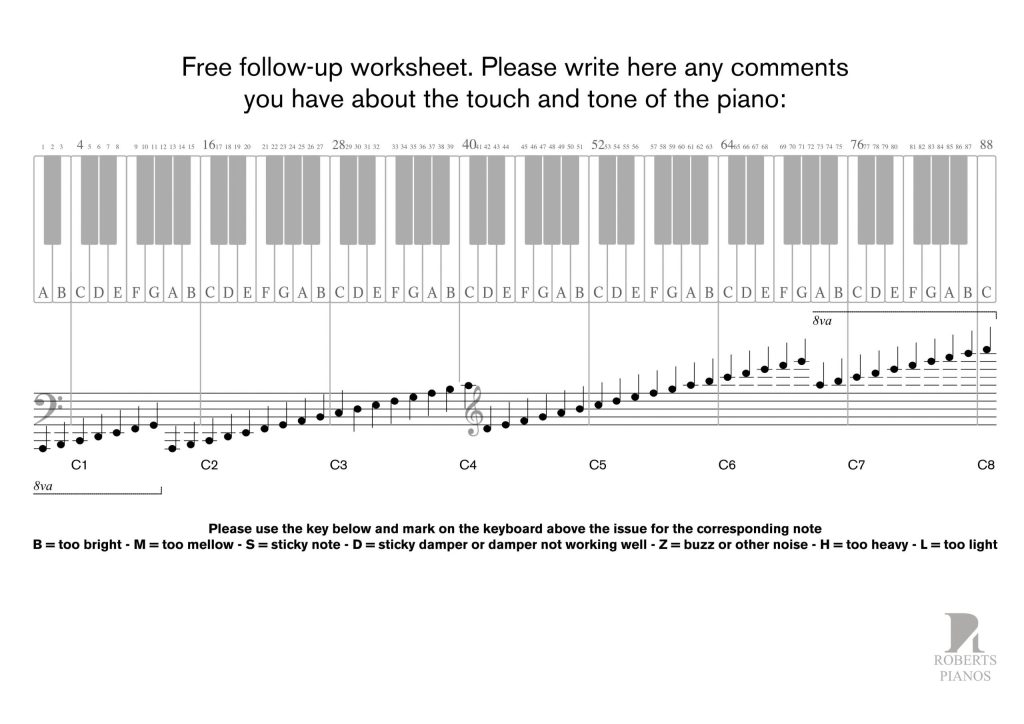
If we have restored your piano please fill out the free follow-up assessment sheet (to download click the image below).
/The work we specialise in:
We specialise in fine restoration of top quality grand pianos, using the best German piano parts and traditional French polishing or modern polyester refinishing as preferred. Before making a decision as to what work your piano needs to have done, we recommend you read the following information.
/The way we assess each piano
Marcus Roberts has been a concert tuner and piano restorer for over 35 years and has a passion to see each piano perform to its best capabilities. In our experience we found that the majority of older pianos have been regularly tuned but never or rarely serviced; it’s therefore difficult to achieve a reliable soft touch, and the tone is also inferior. The quote will detail the most important work that needs doing and place tasks in order of priority. We work to a time sheet and you will be billed only according to the hours worked and parts bought.
/Assessment in transit
We encourage you to make use of our combined removals and inspection service, removing your piano via our workshop where it will be assessed by Marcus Roberts, the owner of the business, who will make a video to help you to think it through. This has a cost of £300+VAT (2024) but will be taken off the charge for any work you commission us to do. We specialise in the removal, restoration and storage of fine quality grand and upright pianos by Bechstein, Blüthner, Steinway, Bösendorfer and other top makes. We undertake any work from minor repairs or casework improvements to hammer replacement and toning or full restoration and top quality French polishing. Assessment is only available for makes of piano with a potential rating of over 65 on our Common Makes pages. It may also be possible to travel to assess your piano in your home. This will entail an extra cost for travel.
/Restoration examples
/More about restoration
Whilst specialising in Steinway, Bechstein and Blüthner we also restore all good makes of pianos, and encourage you to make use of our combined removals and inspection service, removing your piano via our workshop where it will be assessed by Marcus Roberts, the owner of the business, who will write a simple report. Marcus has been a concert tuner and piano restorer for over 30 years and has a passion to see each piano perform to its best capabilities. It’s our experience that the majority of older pianos have been regularly tuned but never or rarely serviced; it’s therefore difficult to achieve a reliable soft touch, and the tone is also inferior. The quote will detail the most important work that needs doing and place tasks in order of priority. We work to a time sheet and you will be billed only according to the hours worked and parts bought.
/How does an older piano compare
with a modern one?
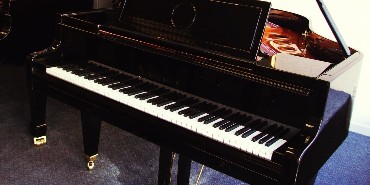
Fully restored Bösendorfer 170 from 1916
The short answer is that top makes of older pianos usually have a superior tone and appearance to modern ones, though good modern pianos will usually have a good touch, whereas badly restored traditional ones may not. The main reasons for the traditional pianos being superior is that from 1880 to 1940 when the piano was the main mechanical item in the home, there were a hundred times more skilled workers in the trade, competition was strong and time was less important. Good hardwood, ivory and other materials were also more readily available. There have been no significant changes in mechanical design since then, and all parts on older pianos are still readily available. Modern pianos from top makers from 1950 onwards can also be very good. They have the advantage of being usually less worn and therefore need less reconditioning. For good ones see the list of makes at the bottom of this page and also our piano makes page.
/The main aspects we take into account
What’s the piano’s current state?
Is a full restoration a must or does it just need regulating and voicing?
We will tone the piano according to the kind of room and type of tone you require.
Finance
When we are asked to quote for work, we take into account the points in this section, always working within your budget.
What kind of touch do you require?
Generally, a lighter touch for older occasional users but a down-weight of at least 50 grams is necessary for beginners as they need to develop their finger muscles and will take exams on a piano having this touch weight.
Will the piano hold its value?
Will the piano hold its value? There is no question of this if it is one of the top German makes – Bechstein, Blüthner, Bösendorfer, Steinway, etc. German makes such as Lipp, Kaps, some Ibach grands, and some English makes such as some Chappell grands and some Broadwoods will fare well in terms of value too. Modern pianos such as Yamaha and Kawai are not built with reconditioning in mind, though good German bass strings make a vast tone difference, and changing worn hammers is a possibility.
Restoration includes the above, but implies much more fundamental work such as major casework repairs, tuning block (wrest plank) and even soundboard replacement. Replacing the soundboard considerably alters the underlying tone of the piano and is not recommended except where it has lost its “crown” or is severely damaged in some way.
A piano that has lost its crown produces a thin and sometimes harsh tone in the mid treble, particularly noticeable around C to F in the octave above middle C (notes 52 to 57). We restore all good makes of piano, though our main full restoration work is on grand pianos by Bechstein, Blüthner, Bösendorfer and Steinway.
/Steinway grand piano restoration
/Detailed aspects of reconditioning
Polishing
About thirty coats of French polish are applied and then polish made from beeswax is added to give an antique style look, bringing out the best grain contrasts. This is done by our team of professional French polishers and we can finish the piano in any style or colour. We try to re-polish the piano exactly as it was originally, though this can be a very lengthy process as “French polishing” requires a very large number of coats. A more basic finish is also available. Costs vary between £2000 and £5500 (July 2022). We can also change the colour of your piano if you wish or do modern polyester finishes if required.
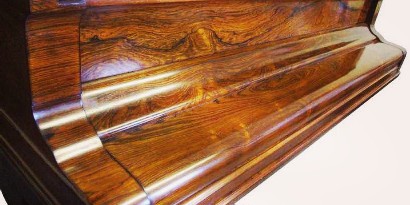
A polished Steinway cabinet
Hammers
Hammers often get too worn or soft, and cannot be made to reproduce the original tone. New hammers are the only solution. We usually fit new ones which are made in Germany, but sometimes recover the existing hammers, again with German or other top quality felt. The decision as to which route to take for a particular piano is one of the most important we make. After installation, the hammers then need accurate aligning to the strings, “travelling”, and once the piano has been fine tuned, toning or voicing. The new hammer makes a world of difference to the tone, bringing out the full harmonic range of the piano. This usually costs between £4,000 and £6,000 (2023), including voicing hammers and weighting the action. Please note that replacing the hammers on your piano will make the touch heavier unless you specify that you want lighter hammers fitted (see also “touch” below).
Hammers
Hammers often get too worn or soft, and cannot be made to reproduce the original tone. New hammers are the only solution. We usually fit new ones which are made in Germany, but sometimes recover the existing hammers, again with German or other top quality felt. The decision as to which route to take for a particular piano is one of the most important we make. After installation, the hammers then need accurate aligning to the strings, “travelling”, and once the piano has been fine tuned, toning or voicing. The new hammer makes a world of difference to the tone, bringing out the full harmonic range of the piano. This usually costs between £2,100 and £3,100 (2020), including voicing hammers and weighting the action. Please note that replacing the hammers on your piano will make the touch heavier unless you specify that you want lighter hammers fitted (see also “touch” below).
Re-facing
This is when there is sufficient felt on the hammer. A vast improvement can often be made by re-facing it. It will then require toning as well. The cost varies from £300 to £650 (2020). Re-facing will reduce the weight of the action, and may also affect balance on uprights.
Toning or Voicing
This is the fine skill of giving each hammer the correct tension. It is done by needling the felt, opening it out so that it rebounds off the string at the correct speed. Normally new hammers are too hard and bright and need “deep voicing” to cause them to bounce off the strings at the correct speed. The technician learns from experience what the correct tone should be. Once the felt is at the right tension, then the hammer is fine voiced. On grand pianos, this includes voicing the piano for “una corda” or soft pedal playing, giving it a mellower tone when the soft pedal is depressed. Cost of toning: full toning about £400 – £700.(2020)
Fitting tuning pins
Loose tuning pins often occur when central heating over time dries the wood on the piano’s pin block, causing the tuning pins to loosen. In most cases this can be cured permanently by replacing the tuning pins with larger ones, though in some pianos, such as the Bechstein upright models I to V, the pin-block itself may need changing. Changing tuning pins accurately is time-consuming costs about £1,300 (2020), and it’s a good opportunity to re-string at the same time if this is thought to be an improvement. Restringing costs between £2,100 and £2,800 (2020); this is usually combined with refinishing and repairing (if necessary) the soundboard, and refinishing the frame. If the pin block needs replacing too, replacing the pin block, repairing soundboard and restringing will cost about £3,700 (2020). This is well worth doing on a good piano as it will make the tuning very stable in central heating.
/Strings
Strings are changed less often as it’s extremely difficult to reproduce the appropriate tone with modern strings. In some cases, such as with Blüthner or Richard Lipp grands, the bass tone can be inferior with new strings. However, if your piano has several broken strings already, then changing them may be the best option. Modern grands can often be improved with new bass strings, sometimes because the original strings weren’t very good anyway! Our replacement German bass strings, for instance, will vastly improve a Yamaha grand piano. Replacing all the strings costs between £1,900 and £3,000 (2020), including refinishing the frame and soundboard. Also bear in mind that if the tuning pins are already large because the piano has been previously restrung, or if the tuning block or wrest plank is damaged, then it will probably need replacing.
/Traditional music desks on modern pianos
Musicians often find that modern upright pianos don’t have a user-friendly music desk. We offer the service of fitting an old-style desk to your piano, with book holders to keep the pages open. We can also fit book holders to modern desks, though if you try this yourself be careful as many modern pianos such as Yamahas have plastic music desks that easily break!
/Fitting a practise pedal (celeste mute)
Most modern upright pianos have a third pedal which when depressed puts a felt between the hammer and strings, allowing the midnight pianist to practice without disturbing anyone! These can be fitted to most good quality older under-damper upright pianos as a lever situated under the keyboard. The cost is around £250 + VAT. (2020)
/Repairing ivory keys
If the ivories are very yellowed, they may benefit from scraping and polishing. Ivory keys (and plastic) need regular buffing on a buffing wheel. We can usually repair or replace chipped ivories with a good match.
/Key touch
Touch
Refers to the smoothness, responsiveness and weight of the action. Top makes of piano can be made to be excellent in all aspects, while it’s often impossible to improve a piano that is cheaply made in the first place. There are, however, basic adjustments that can be made to vastly improve the touch of any piano, such as taking up the slack between the keys and the rest of the movement, adjusting the hammer blow distance or adjusting the “let off” – the distance the hammer travels to the strings before escaping, etc. However, to make fundamental improvements to the touch, extensive work needs to be undertaken. This is because touch is related to two opposing factors: down-weight and up-weight.
Up-weight
Is the force, exerted mainly by the hammers, which causes the action to return to rest. But the pianist needs to feel an even resistance throughout the travel of the key. Up-weight has to do with friction and geometric balance in the action. The up-weight should be between 20 and 25 grams but varies according to different factors and for different pianos. Worn hammers are lighter and therefore produce less up weight. A good pianist can normally tell instinctively if the action “feels” right. Up-weight can often be corrected by replacing loose hinge pins, springs and felts. We strongly recommend that you try the touch on the piano you are going to buy, or if you don’t have the experience or confidence to do this, then make sure you get expert advice on choosing your piano. Older pianos vary greatly; Steinway pianos tend to be heavier, Blüthners lighter, but all pianos can be customised to suit the player. Modern pianos also vary greatly and cheaply made ones often have heavy up-weight. Thoughtful modern firms such as Feurich pay great attention to up-weight. If you are having a piano restored, make sure you tell the restorer what your preference is.
Down-weight
This is simply the weight needed to make the keys go down; but the pressure also needs to be smooth, which is related to good regulation and up-weight (see below). Normally down-weight is set to about 50 grams in the middle with it graduating to 40 in the top treble and 52 in the lower bass. This is ideal for study and powerful playing, but if you are an occasional player you may prefer a lighter touch, down to as little as 40 grams. in the middle. Indeed, the touch of pianos has increased over the years. Pianos were originally modelled on the harpsichord with very little weight; in 1900 the average would have been about 40 grams.