
Small upright pianos:
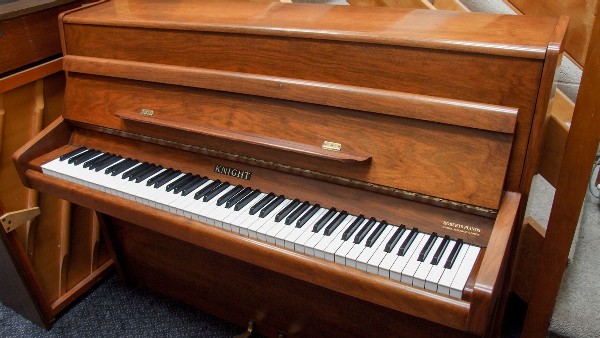
In the UK there are still many fine small upright pianos available made by English firms from about 1960 to 1985. These are generally far better made than the same size piano made today, as from about 1920 to 1985 (uprights from about 1960 to 1985) many British firms specialised in making small pianos. With much competition, high skill levels and great demand, the quality of the best ones was extremely high. The most common good ones are by Knight and Welmar with some but not all of the small uprights made by Kemble, Rogers, Broadwood and Chappell also being well made. As a rule, these English pianos are far better made than the equivalent new ones from the Far East. This is because most of the Far Eastern small uprights are scaled down copies of the taller ones, and often produce an uneven and brash thin tone. Recent examples of this are the Yamaha uprights E108 and LU101 and B1 baby grand which in our opinion don’t have a pleasing tone. Small modern upright pianos date from about 1960 to the present day and the best period of manufacture was from about 1965 to about 1985. Some of these can be quite worn, so much advice is needed before purchasing.
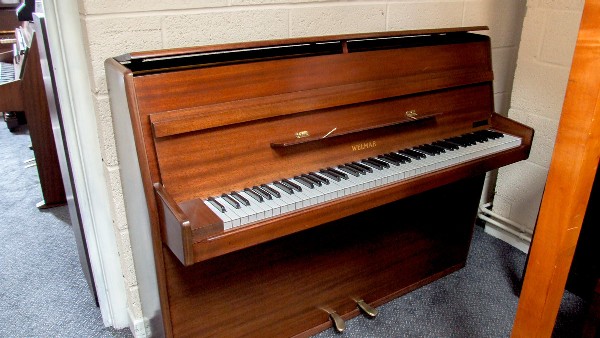
Welmar upright pianos
Small grand pianos
By far the most common of these is the Challen baby grand, which measures between 4ft 4in and 5ft long. They vary a great deal and fluctuated in quality, the worst being passable and at best good. the 4ft 4in ones have a “simplex” action which was good when new or not extensively used, but wears more quickly than the normal roller action. Other good makes which are relatively common are Broadwood, Rogers, Chappell, Cramer and Steck. These also vary considerably. From about 1895 to 1910 Broadwood and Chappell made some very fine 5 to 6ft baby grands, every bit as good as top German ones. Challen baby grands account for over 20% of all those available in the UK. As they specialised in them, the pianos are generally well made, and the best ones are excellent. However, perhaps 60% of them are mediocre. Please see our Challen page for more details. Other makes whose baby grand pianos can be good, are in rough order of availability: Chappell, Cramer, Alison and Rogers. Avoid most of the inexpensive ones which are frequently sub-standard. We recommend Kawai and Feurich as two of the most consistent and trusted modern makes.
Traditional English upright pianos
The most common good quality British upright makers are Broadwood, Chappell, Challen, Steck and Welmar. Again, there is a great deal of variety of British pianos, so consult a good tuner before buying.
Piano advice
Book holders
If you use thick music books, then a pair of book holders can be fitted to most small pianos. Older uprights usually have them, and modern ones and grands usually don’t. Most serious musicians require them.
Practice pedal vs Silent piano system
Some uprights are fitted with a third practice pedal, and we can fit this to most other pianos in the form of a lever under the keyboard. This inserts a piece of felt between the hammer and the strings, making it very quiet. This may be useful if you have thin walls or need to practice in the same room as others, but the tone is not as good as when played normally. We also recommend a practice pedal rather than a “silent” piano as most silent pianos compromise the piano action making it less sensitive, though we realise that some people must have a silent piano so as not to disturb, in which case we can supply them to order and sometimes have used ones in stock.
Are Sostenuto pedals necessary?
Many modern grands and a few older ones are fitted with a sostenuto pedal in the middle of the sustain pedal (right) and una corda (soft) pedal (left). However it does not appear in any classical pieces either used for exams or in the normal concert repertoire, with only a few modern composers writing for it.
Is there enough leg room
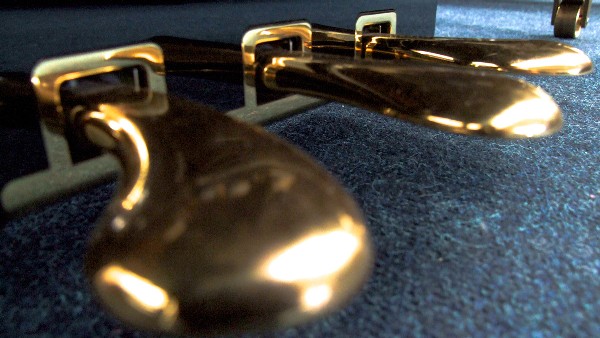
Leg room on small pianos is limited. If you are tall then you will probably have to use a chair which is lower than a piano stool, or an adjustable stool at minimum height. Grands and small modern uprights are usually about 62cm from the floor to the underside of the keyboard. With grands, this can be increased by about 3cm by using glass caster cups; the angle of the pedals may then need adapting as these are raised up too. A Yamaha U3 upright has leg room of 62cm whereas a German Steingraeber 118 has 70cm and an older Bluthner 65cm. A small modern Zender has only 58.5cm!
Small grand pianos (up to 4ft 7in)
The name “baby grand” is said to have been coined by the British firm Challen, who made by far the greatest number of small grands in the UK. Baby grand pianos start from 4ft 3in long by 4ft 4in across the keyboard. The best of these have a pleasing tone and touch, though perhaps 50% of them are not of good quality. Most experts will say that it’s better to buy a tall upright than a small grand, as the string length is no longer on a small grand. However, the action on a grand is generally better than an upright as uprights “throw” the hammer at the string whereas grands “lift” the hammer towards it.
Wooden floors
It’s most important to note that as the soundboard vibrates the sound bounces back off a wooden floor, making the piano sound much louder than it does on a carpeted one. If you are buying a soft toned piano such as an old style Bluthner then this may not be a problem. However if you are buying a bright sounding modern Yamaha or Bosendorfer then it’s likely you will need to put a rug under the piano, and may also need to introduce other absorbent material to the room such as drapes or tapestries. In this way you should be able to arrive at the ideal acoustic. [NB if you have underfloor heating you will have to be extremely vigilant to keep the temperature low and the humidity above 40% and ideally 50%.]